A small pantry has a way of making cooking feel harder than it is. You open the door and a bag of rice leans against a half-used box of crackers. The oil is behind the vinegar, which is behind a tin you forgot you bought. You were going to make soup, but after two minutes of searching you close the door and order something else. The problem is rarely the size of the cupboard. It is that nothing has a place, and so everything has to be negotiated every time you cook.
I have organized more narrow closets and awkward broom-cupboard pantries than I can count, including my own in a Portland bungalow where the “pantry” is a set of shelves barely wider than a baking sheet. You do not need a walk-in butler’s pantry to cook with ease. You need a few honest zones, a lighter shelf, and a habit small enough to keep.
Start by taking everything out, once
It sounds dramatic, but it is the fastest way to see what you actually own. Put a towel on the counter and empty the shelves. Group like with like as you go: oils and vinegars, grains and pasta, cans and jars, baking, breakfast, snacks, teas and coffee, and the stray packages that belong to no category at all. You will find duplicates and the good olive oil hiding behind boxed broth.
This is also the moment to wipe the shelves. Crumbs and sticky rings make a small space feel shabby. A damp cloth and a dry one are enough. Then, before a single jar goes back, do the less glamorous work: the edit.
Edit with one simple question
Hold each item and ask, “Would I buy this again for the way I cook now?” If the answer is no, let it go. Donate unopened food that is still in date. Finish or compost what is tired. Be honest about the specialty ingredient you used once and have not reached for since. A small pantry cannot afford to store a previous version of your life.
Keep a short “use first” tray or shallow basket for anything that is open, ending soon, or already half gone. When you stand at the stove on a weeknight, that tray should be the first thing you see. Cooking gets easier when the house helps you notice what it already has.
Zone the shelves the way you cook
Zoning is the difference between a pretty pantry and a useful one. Give each category a home. I use a simple map in a tight space:
- Eye level: everyday oils, salt, frequently used vinegars, and the grains or cans you reach for weekly.
- Just below: breakfast and coffee or tea, because mornings are not the hour for stretching and hunting.
- Lower shelves: heavier items—stock, jars, and potatoes or onions if the space is dark and dry.
- High shelves: backups, party supplies, and the things you need only now and then.
- A door rack or narrow caddy, if you have one: spices, honey, and small bottles that disappear on a deep shelf.
The map can change with the season. In late autumn I give more room to broth, beans, and baking. In summer, the same shelf might hold more vinegar, crackers, and jars of jam. The point is not a permanent diagram on the inside of the door. The point is that your hands learn where to go.
Decant what you use, not everything you own
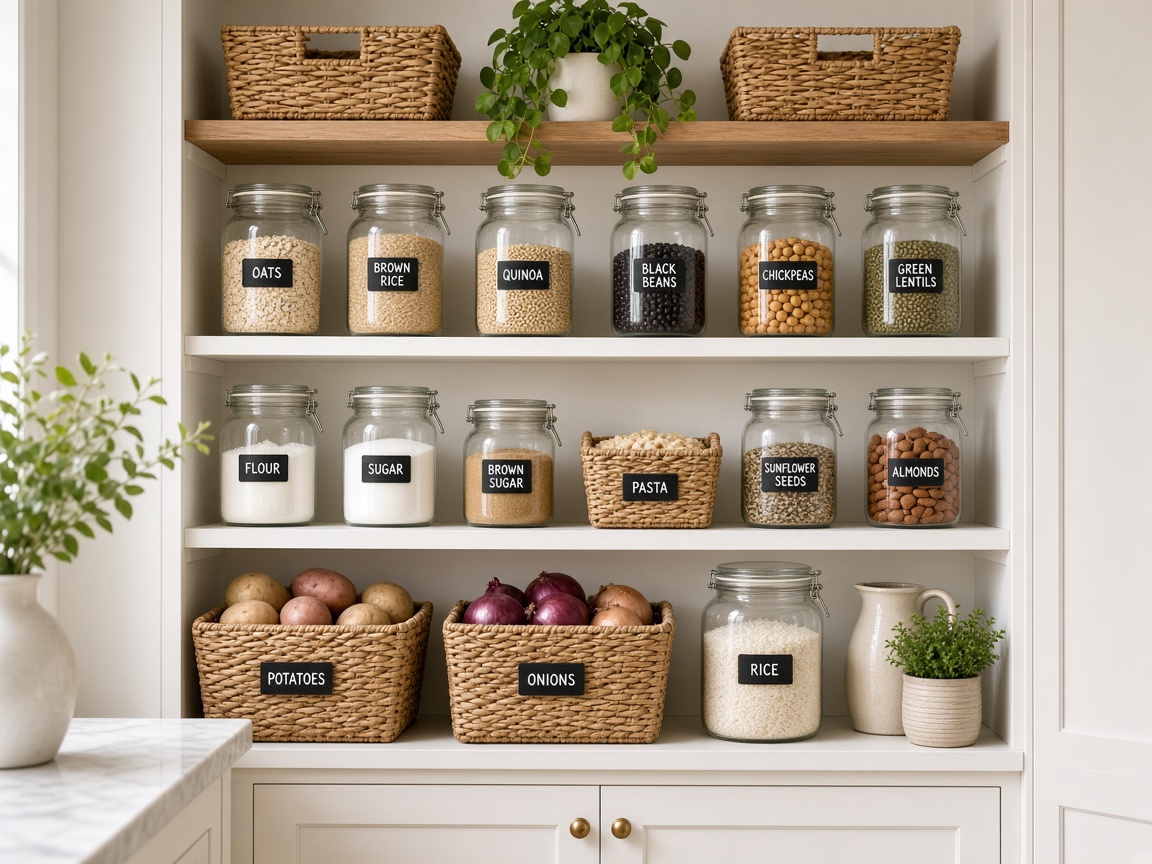
Glass jars are lovely, and they are also a trap. If you empty every bag into a matching cylinder, you will spend a Saturday labeling lids and the following Saturday wondering where the extra pasta went. Decant the staples you use all the time: oats, rice, flour, sugar, coffee, the nuts you toast for breakfast. Leave the rest in tidy original packaging, standing upright, labels facing out.
Choose jars you can lift with one hand and that actually fit your shelves. A wide mouth is worth more than a beautiful shape. A simple label—masking tape and a pencil are perfectly respectable—saves you from opening five containers to find the cornmeal. Keep bulk backups on a higher shelf and refill from there. Baskets hold what will not go into jars. One catchall basket is allowed; when it overflows, edit again, rather than adding a second.
The five-minute Sunday reset
A small pantry stays pleasant only if it is lightly maintained. I do not reorganize every week. I do a five-minute Sunday reset, usually while the kettle boils for afternoon tea. I face the labels forward. I return the wandering bottle of soy sauce to its zone. I empty the “use first” tray of anything finished and move new open items into it. I wipe a shelf if something has dripped. I write a short list of what is actually missing, then close the door.
Five minutes is short on purpose. A system that requires a free afternoon will not survive a real month. A system that can be kept while the water boils will.
What changes in the kitchen
The reward is not a photograph, although a settled shelf is a pleasure to look at. The reward is that cooking starts sooner. You can see the chickpeas, so you make the stew. You can reach the good oil, so you dress the greens instead of skipping them. You waste less because you remember what you already bought. The cupboard becomes, simply, the place where dinner begins.
If your pantry is a single shelf beside the refrigerator, this still applies. One zone, one jar of the staple you use most, one basket for the rest, and a Sunday glance may be the whole method. Scale the idea to the room you have. A well-kept small pantry is not a smaller version of a large one. It is a clearer one. And clarity, in a working kitchen, is what makes you want to cook again.